
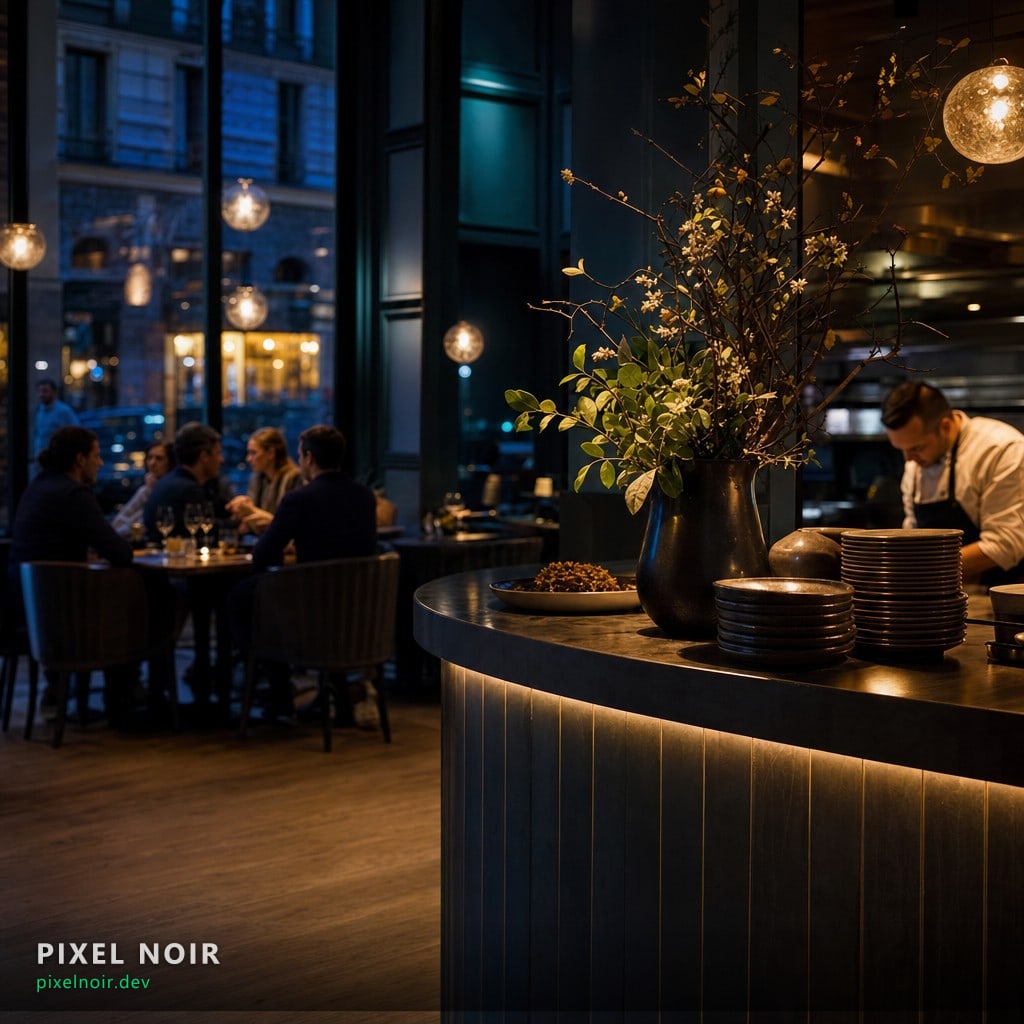
Saturday, 7:45pm. The dining room is filling up, the first plates are leaving the kitchen, your team is in service mode. The phone rings. You pick it up walking past the bar, take a booking for two next Friday, jam the receiver against your shoulder to write on a half-filled notebook. Five minutes later, the phone rings again. And again. While you're writing, a table waves for the bill. And a starter at another table asks if there's a way to add a chair.
This scene plays out every evening in half the restaurants in Brussels. And every evening, it costs you money. Not visibly, but in the background. Calls ringing into the void while you're in the kitchen, confirmations forgotten in the notebook, covers lost because no one could check there was still room, no-shows you discover at 8:30pm. Over a month, that adds up to between 1,500 and 4,000 euros of revenue slipping through.
This article proposes another logic. If your bookings went through a website that never sleeps, that answers at 10pm on a Sunday, that talks to your clients in their language, and that only forwards real questions to your team, your evening service changes radically. Here's how it works in practice.
Why the phone is killing your service margin
A typical reservation call lasts three to five minutes. The client asks about availability, you check the book, you ask for the name, the number of covers, the exact time, any allergies, the mobile number for confirmation. Multiply by two or three calls a night, you lose twenty minutes of service. Twenty minutes during which you're not on the floor, not in the kitchen, not with the clients who are right here.
The other cost, more invisible, is missed calls. When the phone rings during a rush and no one picks up, that client doesn't call back. They try the restaurant next door. In Brussels, two to four missed calls per service is a low average for a busy restaurant. If each call meant a booking for four at thirty euros a head, you're leaving 240 to 480 euros on the table every night. Every night.
What an online booking actually does
Not a basic contact form. A real reservation system has four elements that have to work together:
- Real-time availability. The client sees what's left, not a generic 12pm to 2pm window. If you're full at 8pm, 8pm doesn't show. No double bookings, no accidental overbooking.
- Your restaurant's specific rules. Covers per table, terrace or indoor, no groups on Friday, last orders at 10pm, break between lunch and dinner service. All these rules exist in your head. Studio puts them into the system.
- Useful information for your team. Allergies, occasion (birthday, business), special requests (high chair, accessibility). You know everything before the client arrives.
- Instant confirmation to the client. Automatic email with date, time, covers, address, map. The client has no doubt left, doesn't call back to verify.
The AI chatbot that handles questions outside booking
A reservation is only half the calls. The other half is questions. Do you serve gluten free? Do you have a kids menu? Where exactly are you, I'm in an Uber? Are you open August 15th? Do you take dogs on the terrace? All these questions, Studio's AI chatbot handles them, in several languages, twenty-four hours a day.
The chatbot is trained on your menu, your hours, your constraints, your style. When a Dutch-speaking tourist lands on your site at 10pm on a Sunday and asks if you serve past 9pm, they get a clear answer in their language, not voicemail. When someone asks about lactose-free options, the chatbot can say yes, no, or let me check with the team. Complex or unusual questions, it forwards to you by mobile notification. You see the conversation, you answer in two sentences from your phone, the client gets your answer like they'd called.
For a Brussels restaurant, this chatbot captures three audiences the phone leaves behind: young people who never call anymore, expats who don't speak your main language, and everyone who discovers you at 11pm coming home and wants to book for tomorrow.
The no-show problem and how to halve it
In Belgium, the average no-show rate in hospitality runs around ten to fifteen percent. That's what the industry quietly absorbs. On a service of forty covers, that's four to six covers that don't show, that you can't rebook because you find out at 8:45pm when another table starts their pizza.
Studio limits this with two simple tools. First, an automatic SMS reminder the day before at 6pm, then a second reminder three hours before the service. The client has their phone in hand, sees the reminder, either confirms or cancels. If the cancellation comes at 5pm, you still have time to put the table on a walk-in or a waiting list client. If the client ignores the reminder, at least you know, and you can adjust your prep. Restaurants using this system see their no-show rate drop from twelve to six percent on average. Over a month, that's the salary of a commis.
Menu and announcements, editable from your phone
Your menu changes every month, sometimes every week. Summer card has nothing to do with winter card. Today's special isn't tomorrow's. And yet, in half the restaurants in Brussels, updating the menu on the site means emailing a developer, waiting two days, paying fifty euros, and watching the typo go online anyway.
Studio flips this. You photograph your new dish with your phone, write two lines, hit publish. It's online in thirty seconds, in every language on the site thanks to automatic translation. Same for announcements: closed August 15-22, Italian night this Friday, fully booked tonight, tomorrow still open. A banner on the site, a live update, zero middlemen.
Click and collect and takeaway
More and more restaurants in Brussels add a takeaway offer to their dine-in service. Lunch burgers, evening daily plates, Sunday brunch. Studio handles this flow like a reservation: the client orders on your site, pays a deposit or full amount by card or Bancontact, picks a pickup slot, the money lands directly on your account. No commission on top, no platform taking thirty percent of the basket.
This online ordering logic gets its own dedicated article, we'll come back to it.
Automated Google reviews after service
A restaurant that wants to be visible in Brussels needs Google reviews. Three hundred reviews, four stars and up, that's what tips the scale when someone searches restaurant near me on a Saturday night. The problem is that asking for a review while handing the bill doesn't work. The client pays, leaves, forgets.
Studio automatically sends, two hours after the booking time, a short email to the client: thanks for visiting, tell us how it went. One click, one Google review, your listing climbs. This system, set up on an average restaurant, generally brings in fifteen to thirty new reviews a month with no extra effort.
How it compares to TheFork or Zenchef
Reservation platforms like TheFork or Zenchef offer visibility that may interest a restaurant just starting out. But their model is commission-based: between two and five euros per cover booked via their platform, sometimes a percentage of the basket on promotions. For a restaurant doing five hundred covers a month through their channel, that's between a thousand and twenty-five hundred euros in monthly commission. Plus the subscription sometimes.
Studio works differently. You pay a fixed subscription, which covers all your bookings, your site, the chatbot, the SMS reminders, the automated reviews, and the steering from your phone. Whatever the number of covers. Above two hundred online bookings a month, the math becomes obvious. And crucially, your bookings come through your site, not a platform that can decide tomorrow to push your competitor next door if you don't pay for visibility.
How the rollout works
We start from your current menu, your hours, your constraints. We configure the slots, the capacities per table, the special rules (no groups Friday, last service at 10pm). We train the chatbot on your style and dishes. We hook up Google reviews and SMS reminders. We show you how to change your menu from your phone in three minutes. You're online in two to three weeks.
To go further on what a working website can really do for your business, also read Hire your website in 2026 and Automate beauty salon bookings. If you want to see Studio in action on your case, we discuss it by email or in person.