
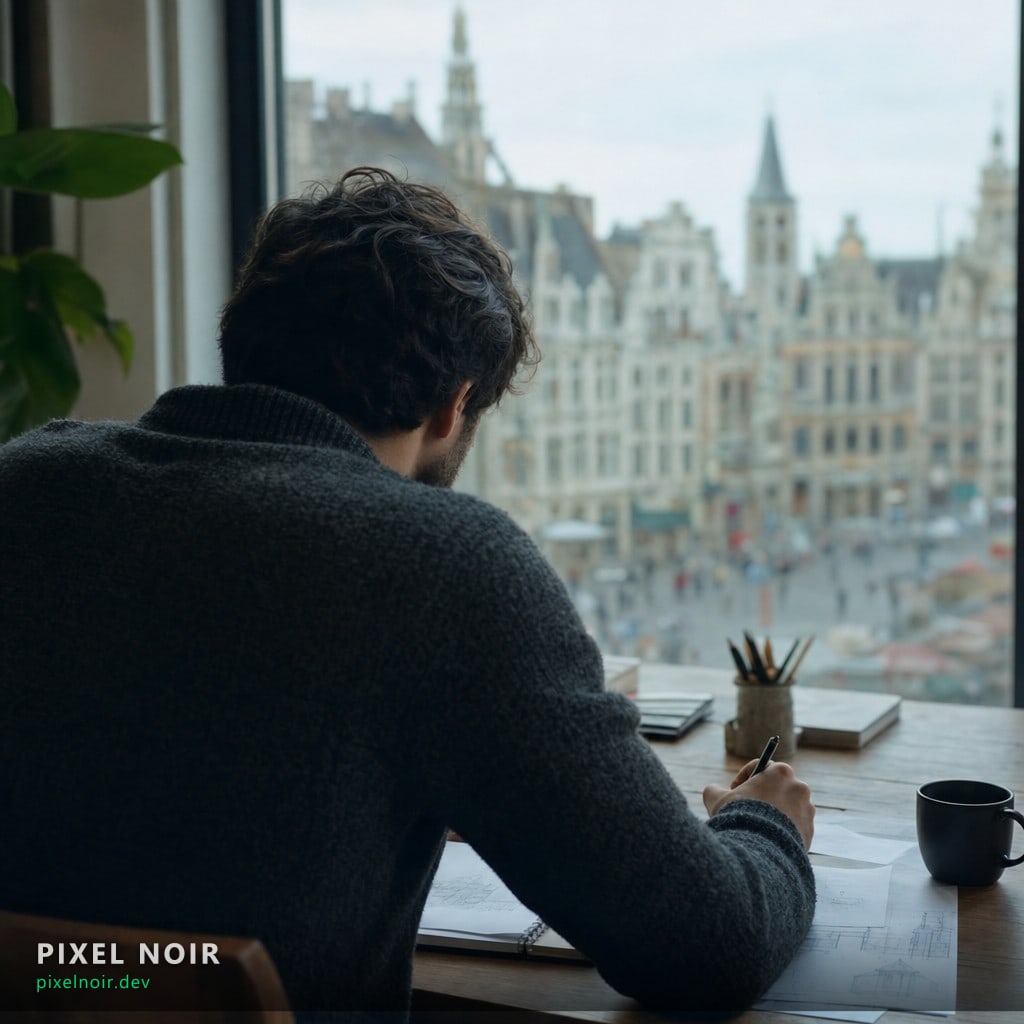
To choose a web agency in Brussels in 2026, check eight concrete points: local roots, understanding your business before the tech, SEO included in the price, serious multilingual handling, measured mobile performance, flat-fee maintenance, features that make the site work, and transparent pricing. Here's how to judge each one, and the traps that cost you dearly three months later.
You type "web development agency Brussels" into Google. You get twenty results, directories, three sponsored ads, and instant fatigue. Every page reads the same: "tailored solutions", "recognised expertise", "human approach". All you want to know is which one will actually deliver a website that works.
This guide is written from the point of view of an independent web developer based in Brussels. Not a ranking, not an in-house comparison. A reading grid to separate providers that produce websites that pay back from those that ship a lifeless brochure you'll forget about in six months.
Why the choice of agency matters more than the choice of design
A beautiful site that's badly wired is still a dead site. A less flashy but properly thought-out site keeps bringing you clients three years after delivery. The difference almost never comes from the palette or the typeface. It comes from the person who asked the right questions at the start of the project.
"How many enquiries a week do you want to handle?", "Which queries do you need to rank for in Google?", "What happens when a client wants to cancel at 10pm on a Sunday?". If the agency doesn't ask these questions, you'll walk away with a site that matches your brief but doesn't deliver the outcome you expected.
The eight criteria that actually matter
1. Location and local roots
An agency based in Brussels (Jette, Schaerbeek, Ixelles, Uccle, Saint-Gilles) knows your market. It knows your clients browse in French, Dutch, sometimes English. It knows the neighbourhoods, the habits, the local competitors. It can drop by for a coffee if needed.
An offshore agency delivers cheaper but stays 4000 km away. When a bug blocks your contact form on a Saturday evening, the time difference becomes a real issue. Proximity is not a luxury, it's a quality safeguard.
2. Understanding your business before the tech
A good provider spends the first meeting talking about you, not WordPress. What services you sell, how you take bookings today, where you lose time, which channels already bring you clients. If the agency rushes to mockups or the CMS choice, that's a bad sign.
Code is just a means. The goal is to turn traffic into real clients. A site that ignores your business doesn't convert.
3. SEO included, not sold as an add-on
A site delivered without basic SEO is a car delivered without wheels. Meta tags, structured data (JSON-LD), internal linking, page speed, proper mobile version: all of that must be included in the offer, not sold afterwards as a 200 euro a month "SEO subscription".
Ask explicitly what's covered on the technical SEO side. If the answer is fuzzy, or if a separate referencing contract is pushed on top of the website, run. Basic SEO is part of the job.
4. Multilingual, handled seriously
Brussels is effectively trilingual, and a tourist city on top. If your activity reaches the general public, your site should at least exist in French and Dutch, ideally in English too. With clean per-language URLs (not a "Translate" button), proper hreflang tagging, and human or proofread translations.
An agency that suggests a Google Translate plugin hasn't grasped the topic. A bad translation on your homepage costs you more clients than it brings in.
5. Measurable mobile performance
Over 70 percent of visits come from a phone. A site that takes five seconds to load on 4G loses half its visitors before showing any content. Ask to see the PageSpeed Insights score of the agency's recent projects. If it floats between 30 and 50 on mobile, the work hasn't been done.
A well-built site exceeds 90 on mobile without tricks. It's measurable, public, and changes everything for SEO.
6. Hosting, updates and security on a flat fee
The site is delivered, and then what? Too many agencies disappear once the invoice is paid. You're left handling WordPress updates, expiring SSL certificates, backups that were never configured.
A serious agency offers a clear maintenance package: hosting, automatic backups, security updates, support when something breaks. All of it at a predictable monthly price, not variable. Ask for the exact list of what's covered.
7. A site that does work, not just a brochure
A brochure site ("About us", "Services", "Contact" pages) has almost zero value in 2026. Everyone has one. The edge is elsewhere: online bookings, automated quotes, a chatbot that answers questions at 10pm, instant deposits, SMS reminders to clients.
A good agency proposes these features depending on your business, not as an exotic option but as a central part of the project. That's precisely the angle of Pixel Noir Studio.
8. Transparent pricing
Beware of quotes without detail ("brochure site, 4500 euros incl. VAT"). Ask for the breakdown: design, development, content, hosting, post-delivery support. An honest agency knows where every euro goes.
In Brussels in 2026, the entry ticket starts at 500 euros for a simple site, delivered as is (classic pages, contact, business presentation). You have your site online, clean and fast, but you don't touch it again once delivered.
For a site you can manage from your phone (edit content, handle bookings, follow client requests, receive notifications) and that stays maintained over time, expect a build set on a per-project quote, plus a monthly plan from 49€ covering hosting, maintenance and the mobile control interface. You're no longer paying for a frozen site, you're paying for a tool that evolves with you.
The moment you add intelligence layers (chatbot connected to your catalogue, automatically generated quotes, business automations, advanced bookings with deposit and SMS reminders), the price climbs noticeably, because the value the site produces climbs too.
Beware of offers at 200 or 300 euros: at that level, either it's a recycled template with no support, or the hidden cost surfaces later (inflated hosting fees, extra charges on every change, full lock-in to a proprietary tool you can't migrate from).
Three classic traps in Brussels
- The "free site" trap from your hosting provider. Usually a generic template, locked to their infrastructure, that you can't migrate the day you want to switch. The real price gets paid later.
- The disappearing freelance trap. Attractive quote, decent delivery, then no more replies to your emails. Prefer an established structure, verifiable in the Belgian BCE registry, with a stable point of contact.
- The agency that won't show its work. If you're refused three live URLs from production projects, it's because there aren't any, or they're not presentable. Always ask to see real work, not Figma mockups.
Questions to ask at the first meeting
Five questions that separate a serious provider from a salesperson rushing to sign:
- How many projects similar to mine have you delivered in the last twelve months?
- What mobile PageSpeed score do your live sites reach?
- What happens if I want to add a feature six months after delivery?
- Is basic technical SEO (markup, speed, structure) included in the quote?
- Who will be my direct contact during and after the project?
An agency that answers these five clearly will give you a realistic frame. An agency that dodges them will waste your time.
And concretely?
Pixel Noir is me. From Jette, in Brussels, I design and deliver sites that take bookings, handle quotes, answer clients at 10pm, and keep working while you sleep. Hosting, maintenance and support included in a predictable monthly plan.
If these criteria sound right to you, let's talk it through. To go further on what a site that works for you can really do, also read Hire your website in 2026.
Frequently asked questions
How do you spot a good web agency in Brussels?
It asks about your business first, includes basic SEO in the price, shows live production sites with their URLs, and offers a clear flat-fee maintenance. If those points are dodged, walk away.
Should you choose a local or an offshore provider?
A local Brussels presence matters: same language, same market, and someone reachable when something breaks on a Saturday night. Offshore is cheaper, but the time difference and distance cost you in responsiveness.
Should SEO be charged as an extra?
No. Basic technical SEO (tags, speed, structure, mobile version) is part of the job and should be included in the quote, not sold separately as a monthly subscription.
What budget should you plan for a site in Brussels in 2026?
From €500 for a simple showcase site delivered as is. For a site you manage and that stays maintained (Studio), the build is on a per-project quote, plus a monthly plan from €49. The price rises with features (booking, quotes, chatbot).